Building an Effective AI Knowledge Base: Best Practices
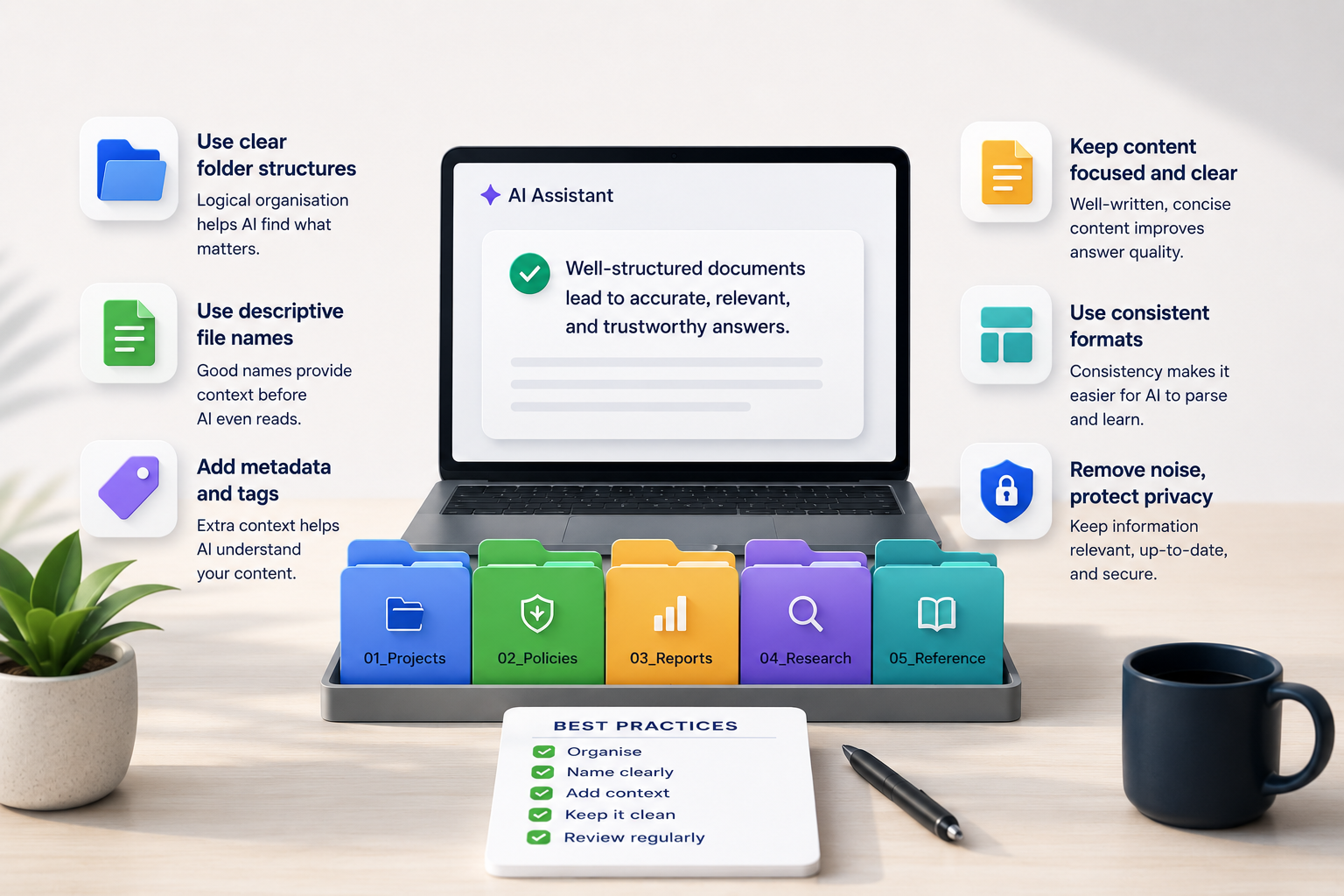
Your AI Is Only as Good as Your Documents
The most common reason AI assistants underperform isn't the model — it's the knowledge base. Poorly organised, outdated, or incomplete documents lead to poor answers.
Here's how to set your AI up for success.
1. Start With Your Most-Asked Questions
Before uploading anything, list the top 20 questions your team or clients ask most often. Then find or create documents that answer each one clearly.
This "questions first" approach ensures your knowledge base is immediately useful rather than theoretically comprehensive.
2. Prefer Structured Documents
AI retrieval systems work best with well-structured documents:
- Use clear headings and subheadings (H1, H2, H3)
- Keep paragraphs focused on a single idea
- Use bullet points for lists of items
- Include a clear title and summary at the top
Avoid walls of unstructured prose — they're harder to chunk and retrieve effectively.
3. Keep Documents Up to Date
Stale information is worse than no information. An AI confidently citing an outdated policy creates real problems.
Set a regular review schedule for your core documents. Mark time-sensitive content with explicit dates so it's easy to identify what needs updating.
4. Organise by Topic, Not by Department
It's tempting to mirror your org chart in your knowledge base. Resist this instinct.
Organise documents by the questions they answer, not by who owns them. A client asking about billing doesn't care whether the answer lives in Finance or Customer Success.
5. Include Context in Each Document
AI retrieval systems pull individual document chunks, not whole files. Each section of your document should make sense on its own.
Bad: "See above for details." Good: "Our refund policy (updated Jan 2026) allows full refunds within 30 days of purchase."
Start Small, Iterate Fast
You don't need a perfect knowledge base on day one. Start with 10–20 high-quality documents, connect your storage, and measure which questions can't be answered well. Then fill those gaps.
An iterative approach gets you to value faster than trying to boil the ocean upfront.